Showing posts with label As I Please. Show all posts

Saturday, November 30, 2019

Salleh Ben Joned and the Art of the Pantun (by Alima Joned)


By Alima Joned

My brother Salleh and I are as different as night and day. At 5’ 11” he is tall for a Malay, with the rugged sexy looks of a Mick Jagger. In contrast, I am no Malay beauty, and I am also so short that Salleh once teased I must have stopped growing at the age of four.

We have different temperaments. And we pursued totally different career paths. He found his calling in poetry, I found a career in law.

A poet first and foremost, Salleh was also a columnist and essayist, writing the popular column ‘As I Please’ for the literary page of Malaysia’s major newspaper the New Straits Times in the 90s.

In introducing Salleh’s collection of essays and columns, Nothing is Sacred, Malaysian poet Wong Phui Nam wrote:
More than anyone else, Salleh contributed to the rapid success of the [literary] page. Readers recognised immediately his wit, ironic humour, biting criticism, the rare capacity to entertain and verbal vigour. Here was a man who had much to say and he said it in a style that made his words bring to the reader his very presence. But if it were only a matter of style, however provocative and highly entertaining As I Please was, it would, of course, have turned out to be of passing interest. What it was about would by now be passé, eight years down the road into a new century.  But the many things Salleh had to say were then, and still are, important and relevant.

Salleh lives and breathes words, while I simply use them to make a living. So while I enjoyed his columns, back then I couldn’t say the same about his poetry.

But all that changed recently after I re-read a couple of his old columns that helped me rediscover the beauty of pantuns.**

Rediscovering the beauty of pantuns

The first column, titled "Brother Henri, Honorary Malay," was on the French writer, Henri Fauconnier, whose semi-autobiographical book The Soul of Malaya, is interspersed with pantuns and Malay proverbs.

Salleh considers the book to be the best book ever written by a European about the Malays – their psyche and sensibility.

He notes in particular how Rolain, Fauconnier’s main character in the novel, ruminates on the nature of the Malays, the uniqueness of the Malay language, and the aesthetics of the pantun form.

I had already read the book some years before, but picked it up again to see what Salleh was talking about.

Growing up as a kampong girl myself, I was familiar with popular pantuns, but in Fauconnier’s book I found unfamiliar and at times naughty pantuns that drew a smile to my face.

In another column, "Salacious Pleasures of Pantuns," Salleh argues if people read a pantun properly, sensitive to the semantic and cultural resonance of key words, they would see more than the surface evocation.

For these reasons, pantuns were much beloved by the late renowned translator, poet and scholar Burton Raffel. Unfortunately, as Raffel notes in The Art of Translating Poetry, the pantun is a kind of poetic form that “has not travelled well.”
Due to the nature and the uniqueness of the Malay language, pantuns are not easy to translate.  When translating a pantun, in Raffel’s view, it is difficult for a translator to capture “the true thrill of the form’s careful, subtle variations.” Raffel seems to say the job is almost impossible, even if the translator is himself a poet with the mastery of both languages.

Yet, I think Salleh has managed to do a pretty good job at meeting this challenge. Consider two translations of the opening lines of this classic pantun:

Tanam padi di Bukit Jeram
Tanam keduduk atas batu
Macam mana hati tak geram
Menengok tetek menolak baju

In Fauconnier’s book, we are given a literal translation.

Planting rice on Jeram hill
Rhododendrons on a rock
However, could my heart keep still
Seeing her breasts move beneath her frock?

To retain the thrill of the original, Salleh translates this classic as follows:

Plant the padi with a thrust
Stroke the seedlings with dew
It drives you crazy with lust
To see the tits tilting the baju (blouse)

Salleh’s translation of the first two lines is a very free rendering of the original.

Readers who appreciate the fluidity of Salleh’s translation would forgive him for taking liberty with the translation so that the thrill and beauty of the original language can be retained.

I had so much fun reading this classic pantun after discovering it in Fauconnier's book, especially when reading it aloud to my sisters – who have become increasingly religious in recent years.

But beyond fun, Salleh argues pantuns are a way of understanding the Malay sensibility:
The central word for the pantun, hati (literally liver, but the English equivalent here would be heart), is also the key word in Malay folk physiology. The liver to the Malays is traditionally the seat of the passions. (This was also the case in ancient English belief: you can find it surviving in Shakespeare’s plays and poems.) The hati, the organ that conceals the secret of the Malay as a creature of feelings and passions, is vital to any attempt to understand the race. If you want to know what the hati is to the Malay, soak yourself in the pantuns.

Salleh’s use of the pantun form

Salleh also writes poetry in pantun form himself. Many of his pantuns are witty and playful. But they can be serious at the same time – noting unpleasant truths about his race and country. There’s a “courageous seriousness,” according to Margaret Drabble in her introduction to the first collection of Salleh’s columns, As I Please, “beneath the wit and the invective of Salleh’s writings.”

Below is Salleh’s poem in pantun form inspired by the Anwar Ibrahim imbroglio of 1998, which appears in his book Adam’s Dream:

What makes the parrot a very queer bird?
Its talent to mimic and its hooked bill.
Alima & Salleh in 1977
 
What makes the shrill patriot a cringing turd?
Because he has the brain of a mandrill.

Why does the katak love its tempurung?
It’s so cozy and good for inbreeding.
What do we always confuse right and wrong?
Because of our refined Malay upbringing.

Why do pigs really love to wallow in shit?
Because they are pigs and true to their kind.
Why do we swallow whole those affidavits?
Cause we have an ape’s mouth and a mouse’s mind.

Why do the gullible value snake vomit?
Because old superstition taught them to.
Our Anwar as seditious sodomite?
Those Front buggers swear to it; it must be true.

When is a cabinet very valuable?
When you have bits of skeletons to hide.
When does a DPM become dispensable?
When the PM says he is a Jekyll-and-Hyde.

Why do snakes love so much to slither in slime?
Because that is where they get their best feed.
“Ministers get sucked” all the bloody time?
What a revealing typo that was indeed.

Why are all the sawah full of tikus?
Because the harvest’s such a miracle.
What makes our Mahashita think he’s Zeus?
Thanks to our media that’s so farcical.

katak – frog
tempurong – coconut shell
sawah – padi field
tikus - mice

Many of Salleh’s pantuns are expressions of love – for his wife Halimaton, his children and friends.

Salleh’s poetry has drawn fans and detractors alike

It is not my place to comment on his contribution to Malaysian literature but I am curious what lovers of language and poetry think about his musings on pantuns.

And, if, like me, you had no education in poetry, nor any natural talent for it, this Malay form may be the perfect starting point for gaining a better appreciation of poetry – and Malay culture.

After a decade in a foreign land, my brother came back to Malaysia anxious to recover his lost cultural self.

Being a man of words, he naturally made attempts to repossess his mother tongue and began to write prose and poetry in Malay, making innovations in the art of pantun along the way.

Some claim my brother’s work is too Westernised – to the extent that he has betrayed his race and religion, and lost his Malayness.

In some ways Salleh is quite Westernised – he acknowledges this. But he is still very much Malay and so terribly proud of it. In his column The (Malay) Malaysian Writer’s Dilemma, he writes:
I am aware that I am in some ways quite Westernised, and I am not embarrassed by it. In fact, there are elements in my Westernisation that I am quite happy about, which I’d like to believe have made me a better human being and hopefully a better writer. But I also feel I am still, in some things, incorrigibly Malay. And I don’t regret that either. In fact, there are things about 'Malayness' (not to be confused with ‘Bumiputraness’) and in the cultural heritage of my race that I am terribly proud of. That’s why I like Lin Yutang’s unusual definition of patriotism (or eating, it doesn’t really matter which) as love for the good things one ate in one’s childhood. I am quite certain that these things, in my case sambal belacan (Malay delicacy) and cencalok (Malay delicacy), both literal and metaphorical, inform my writing, especially the poetry. Directly or indirectly, they give much of whatever energy my writing can claim to have.  
My brother is also “incorrigibly” Malay as far as the pantun is concerned. In their simplicity and directness, pantuns are indeed beautiful and elegant. Through his artful and skillful translation, my brother enables native and non-native speakers of Malay, poets and non-poets, to truly appreciate the aesthetics and the beauty of classical pantuns. In writing his own pantuns, making innovations along the way, he uses the form to speak on weighty matters with lightness no one else could. Either way, my brother has made the art of pantun not only travel well, but travel further.

31 December 2018


_______

Alima Joned is a lawyer in private practice in Washington, DC. 

** The pantun is a classical Malay poetry form with four line verses, usually with the rhyming scheme of a-b-a-b. The first two lines are linked in some way to the second two. As long as the form is followed, a pantun can be on anything, from an irony of fate to words of advice to an expression of love.


Friday, February 19, 2016

Preface to 'As I Please' by Salleh Ben Joned (1994)

This is the first of a number of posts from SBJ's 1994 selection of essays and columns 'As I Please' - many of his articles published in this book originally appeared in the New Straits Times where Salleh had a column by the same name (no doubt in honour of George Orwell).

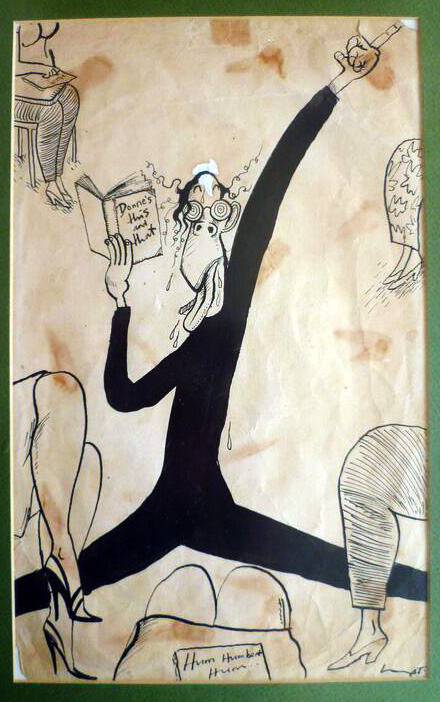
Salleh Ben Joned at a poetry reading (by Lat)

A word about my New Straits Times literary column, As I Please (AIP). The pieces, selected from a very uneven bunch, written, with occasional breaks, over a period of three years (1991-4) are presented here as they first appeared, with all their sense of topical fervour, urgency and the need to meet the deadline. Whatever minor cuts, insertions and changes in phrasing that have been made were dictated by the needs of the non-Malaysian reader.

AIP kicked off on March 6, 1991 with a confident commitment to regularity. Quite soon it became “As and When I Please” to the dismay of the paper’s long suffering literary editor and the incredibly tolerant followers of the column. You see, I belong to the vanishing tribe of “Old Malay” – which the currently much talked about “New Malay” would no doubt dismiss as lazy, irresponsible, cynical. indisciplined, unpredictable, fun-loving and therefore unreliable. I must be one of the most, if not the most, irregular, columnists in the history of journalism. But this hopeless, so-called columnist, despite intermittent seizures of doubts about the quality of his writing, is sure of one thing. The column, if nothing else, triumphantly proved that one must never, never censor oneself, and that one should always, as they say, “test the parameters.” Malaysian writers need to be reminded of this all the time - and I am sure the situation is not much better in many so-called Third World countries. 

Many people have expressed surprise that I was allowed to get away with saying things I said in As I Please in a country like Malaysia and in an establishment newspaper like the New Straits Times. The fact that Kadir Jasin - an intelligent man and a Malay (it’s worth noting) - was Group Editor of the paper explains the freedom I was tacitly granted. But that freedom would not have meant much if the Literary Editor (Kee Thuan Chye) had not been what he was - committed to “testing the parameters.”

Not a few readers praised me for my so-called “courage”; I personally didn’t think it was a matter of courage. Common sense - that’s basically what’s needed. That, and a real concern for the intellectual state of the country. I was furious when V.S. Naipaul - interviewed while in Malaysia researching for his book, Among the Believers - so casually said that mine was a “country without a mind.” But I knew what he meant, and if we confine that remark to the contemporary scene I couldn’t help but agree with him.

I’m a stinking big mouth, I know. But I really can’t stand the parochialism of my fellow Malaysian, especially Malay (or Bumi) writers. The contemporary Malay writer as a type (which means there are exceptions) is an utterly predictable, cliché-clogged, slogan-sloshed pretentious, sentimental, deadly solemn and therefore humourless animal. He takes himself so, so seriously - and for all his intellectual pretensions, he knows nothing about the big world. The Malay word for writer is sasterawan (Sanskrit in origin), and I must admit in my polemical usage the word has acquired a prejorative connotation. And thus the charge against me that I have blasphemed against the Holiest of Holies, the inbred figure of the Malay sasterawan, the shrill articulator of the Soul of the Race (race, not nation, mind you), that pious and sentimental defender of the glory of the Great Malay Minda (from the English “mind”- you see, we don’t even have a word for mind!). Blaspheming as I please against the sasterawan doesn’t take much courage - and it can be fun. But I must admit my pieces on Salman Rushdie, especially the last one, (Speaking Up for a Writer’s Right, December 15, 1993) were a little reckless; my wife thought this time I was really asking for it. But Allah the All-Knowing, All Compassionate apparently didn’t think I had committed any mortal sin (no lightning has struck me yet). There was, however, a flood of correspondence (one was ten pages long), and all of it very fiery and very condemnatory, consigning me to hell with pious enthusiasm. The one from the Iranian Embassy Press Attaché came very near to demanding that I, a freelance writer, be “sacked” [sic] from the New Straits Times and be compelled to apologise to the government and people of Iran and the Muslim Umma (community) for insulting the memory of the Ayatollah. This letter was among those that were published before the correspondence on the subject was promptly closed by the Editor; but the paragraph containing the “demand” had unfortunately been edited out.

Writing a literary column in a country like Malaysia can be quite trying. The issues that matter keep recurring again and again, and when you want to be positive, to have the nice feeling of praising a writer or some writing for a change, there isn’t very much to shout about. Thus my self enforced soul searching, soul saving, khalwat from the column every month. The word khalwat, incidently, is of Arabic origin and it means “spiritual retreat.” In Malaysia, it has come to mean “retreat for immoral purposes” or sexual “close proximity,” a crime-sin which is punishable by the syariah law (it only applies to Malay-Muslims - so much for the special rights and privileges of the Malay-Bumis).

This obscene, nay, sacrilegious transformasi of the word khalwat is a perfect figure for the general perversion of values, of the spirit, intellect, heart, life and inevitably language - all in the name of an abstract piety (in this case, religion; in another, race). If I were asked what motivates my writings, I’d say simply: the crying need to say “No! In thunder!” to this perversion. No, in the name of Yes-to-life. Yes!

 Salleh Ben Joned 
Aldie, Virginia, U.S.A. 
 22 May 1994


Introduction to 'As I Please' by Margaret Drabble (1994)

Dame Margaret Drabble CBE (portrait by Ruth Corney)
Anybody who wants to understand cultural politics today should read this book. Anybody who wants to understand Malaysia today should read this book. And anybody who wants an insight into confrontations of East and West, of Islam and the secular or Christian world, should read this book.

Salleh Ben Joned, poet and journalist, is an excellent guide through the minefields of misunderstanding that await the traveller at home or abroad. The articles and essays cover a wide range of issues, from the question of the National Language (and National Literature) of Malaysia to the death of Lorca, from the soporific dullness of hot Sunday afternoons in Kuala Lumpur to the Rushdie Affair, from erotic verse to the implications of the Fall of Granada in 1492.  Salleh is a joker and a satirist, and he can make one laugh aloud, but beneath the wit and invective is a courageous seriousness. Ridenten dicere verum quid vetat?  As Horace said – or “Who says I can’t joke while telling the truth?” - Salleh’s jokes are often very near the bone, as are those of the best jesters, and he probably annoys his friends as often as his critics.

He writes in a political climate which is, to say the least, challenging. Malaysia should be grateful to him for communicating to outsiders so clearly and enjoyable its condition as it approaches the Millennium – though I suppose gratitude is what it always feels. After reading these essays, one has much more understanding of what is actually happening in a country whose relationship with Britain has recently been very vexed.

One can even pick up, from this volume, a few words of the language – it was Salleh himself in Kuala Lumpur who taught me the provenance of the word “amok”, and from these essays I have now learned that in Malay, breasts are tetek, a word which he lovingly describes as completely expressive of itself, and more evocative than any English version, literary or vulgar. His translations of Malayan pantuns, sayings and terms of abuse also make one long to know of the language. It is clearly a fine tongue for invective.

Born in Malacca, Salleh had a Western education in Australia and Tasmania, and is now widely travelled, but he remains a Malaysian and a Muslim. He is uniquely well placed to explore what has recently become a dominant cultural conflict of our time. Like Rushdie, he has lived, day by day, and tried to make sense of it.  His responses are instant, off the cuff, sometimes hasty – and that is one of the virtues of this volume of occasional pieces. It has a great immediacy. The debate is with society, and he shows us a mind unable to censor itself. He explores the Quran and the Hadith, finding there mercy and compassion: he challenges the dictators of religious orthodoxy on their ground, pleading for a tolerance which he assures us has scriptural authority.

This is a brave agenda. The word “blasphemy” and “sacrilege” and apostasy understandably haunt him, and he says that his typewriter has a curious habit of producing the word “scared” instead of “sacred.” His courage in trying to interpret one side of his heritage to the other, and hence to us, is exhilarating. 

Salleh is bilingual, and writes in English and Malay:  he supports strongly the right to write (and teach and be taught) in English, but he also has a strong feeling for Malay. His games with words in both tongues reveal his knowledge of James Joyce, of whom he here writes with admiration – making, incidentally some interesting comparisons between Irish nationalism and Malaysian nationalism. He is sensitive to the grey area where religion fades in which literature itself can be co-opted, abused and misinterpreted. He votes for multi-culturalism, but he also understands its dangers. 

Exhilarating, too, is the infectious enthusiasm with which he writes about writing. His friends and heroes, ranging from the Australian poet and trickster James McAuley to Octavio Paz, Ibsen, Chairil Anwar (“the first and probably the only true bohemian and rebel the Malay literary world has produced”) and journalist and novelist Isako San, are celebrated with generosity.

Above all, he arouses our curiosity. He makes us want to understand. For this alone Malaysia should give him a few medals. Who would have thought I would find myself reading an article on a Bumi writer’s dilemma with such interest? Until I came across Salleh Ben Joned, I never even knew what a Bumi writer was. This book challenges us all to find out

Margaret Drabble
May 1994


Margaret Drabble is a novelist and critic. Her first book A Summer Birdcage, was published in 1962 to be followed by several others, including The Garrick Year (1964) The Needle’s Eye (1972) and The Radiant Way (1987). Her book The Millstone (1966) won the John Llewelyn Rhys Prize. She is editor of The Genius of Thomas Hardy (1976) and the Fifth Edition of the Oxford Companion to English Literature (1985) and author of a critical biography of Angus Wilson. She was awarded a CBE in 1980.

Tuesday, February 16, 2016

Rojak is Good for Nation-Building (1992)

Rojak buah - a popular Malaysian salad

The first of the nine challenges posed by Vision 2020 is that of creating by the second decade of the next century a united Malaysian nation which is ethnically integrated and harmonious. This amounts to an admission by the Government that, more than three decades after independence, we are still not a nation in the full sense of the word. Those of us who would agree with this belong to two main categories. There are non-Bumiputeras who believe that the officially sanctioned “Bumi/non-Bumi” dichotomy is the root of most of the obstacles to the emergence of a true nation. And there are the Bumiputeras who claim that we are not a true nation because we don’t have linguistic and cultural unity. It is not my intention here to discuss all the reasons that have been offered to the absence of true nationhood. I only want to look at the linguistic reason advanced by the Bumiputeras, and to discuss it in relation to literature. Since literature is part of culture, what I have to say may have some bearing on the thorny issue of “national culture.”

One of the many responses to our Prime Minister’s call for a critical discussion of his Vision 2020 is a booklet I’ve just read called Wawasan 2020 dan Pembinaan Bangsa Malaysia (Vision 2020 and the Building of a Malaysian Nation). Published by the Department of Anthropology and Sociology, Universiti Kebangsaan Malaysia (National University of Malaysia), the booklet is the result of a dialogue held last year by a group of UKM academics. The views expressed in it can be considered representative of the dominant thinking among the Malay intellectual elite.

All the academics in the dialogue more or less agree that the two main reasons for the failure of a true Malaysian nation to emerge are (1) the unwillingness of the majority of non-Bumis and a section of the Bumi elite to show a genuine and full commitment to the national language; (2) the persistence of cultural pluralism despite demands by the Bumi literati for a full implementation of the National Cultural Policy. The academics are particularly concerned about the continuing presence of the language of our former colonial masters. They lament the fact that English is still very visible everywhere in this country; on TV, in the print media, in all forms of advertising, on shop signs, at the cinemas, in bookshops and other places. In the private sector, English is the dominant language of communication. Private colleges with English as the medium of instruction are allowed to function freely.  These academics further complain that even the younger generation of non-Bumis who were educated in the National Language prefer to speak English or their own language when there is no official compulsion or expectation for them to speak in the National language. With TV-watching  constituting a large portion of their leisure time and English newspapers, magazines and books their preferred reading material, it is not surprising that English is their usual medium of communication.  But what the UKM academics are really sad about is the fact that a sizable section of the Malay elite, especially the businessmen, prefer to speak in English not only to non-Bumis but among themselves too. What’s worse, they even think in English!

The Government is taken to task for compromising on the issue of national language; for allowing English to be so visible in many areas of public life. The Government, it is repeatedly stressed in the dialogue, must apply the law rigorously to ensure that only the National Language is used in situations where such use is legally enforceable. It is even implied that the Government should extend its legal powers, presumably through new acts of Parliament or amendments to the present National Language Act, to ensure that the status of Malay as the sole official language is respected. The implication is strengthened by the proposal that there should be a National Culture Act to correspond with the National Language Act. Such an act, it is argued, would ensure the end of kebudayaan rojak (Salad culture) – a colloquial expression for “cultural pluralism” or “multiculturalism.”

One of the academics is sceptical about the fifth challenge posed by Vision 2020, that of creating a liberal and tolerant society in which Malaysians respect each other’s creeds and customs. He wonders if this is not an approval of kebudayaan rojak.  Another even more uncompromising academic actually accuses the Prime Minister of inserting the dangerous idea of “democratization of culture” in his Vision 2020. This same academic categorically asserts that “nasionalisme Malaysia bererti … nasionalisme bumiputera, dan Wawasan 2020 perlu dikudung oleh nasionalisme bumiputera ini.” (“Malaysian nationalism means … Bumiputera nationalism, and Vision 2020 must be buttressed by this Bumiputera nationalism”) He also prophesies that if the present widespread use of English is not checked, “bangsa Malaysia pada tahun 2020 ialah bangsa yang fasih dalam Bahasa Inggeris.” (“the Malaysian nation in the year 2020 will be a nation fluent in the English language”) (I didn’t know that to be fluent in the lingua franca of the world is a bad thing.)

The booklet as a whole strikes me as a rather regressive document which shows that ethnocentric thinking is still very strong among the Bumi intellectual elite. They are not yet psychologically liberated to use a phrase from Vision 2020. The document weakens even more the little faith that sceptics like me have in our ability to meet the challenges of creating a united nation which is ethnically integrated, and a mature democratic society which is psychologically liberated, liberal and tolerant. The suggestion in the booklet that non-Bumis who don’t speak the National Language all or most of the time are ipso facto not Malaysian in spirit, and those Bumis who are bilingual are renegades, is nonsense. And the allegation that the non-Bumis are more conscious of their ethnic identities than their identity as Malaysians is only worth entertaining if the UKM academics are prepared to be honest about the Bumis’ own sense of identity. Aren’t they also like the non-Bumis in this respect? One of the academics actually admits it, and I commend him for his honesty.

On the question of cultural pluralism, we must be realistic. As realists have often pointed out, kebudayaan rojak is inevitable given the multi-ethnic nature of our society in which no one race truly dominates in terms of numbers. Anyway, what’s wrong with kebudayaan rojak? Malaysians like rojak. It’s good for them, and it helps nation building. Unity in diversity is certainly better for the vitality of our cultural life than the imposition of an artificially conceived national culture through legislation. A living culture, as everyone knows, grows naturally; it cannot be programmed or legislated according to an abstract recipe. And it is disingenuous of the UKM academics to blame linguistic diversity, in particular, for the failure of a true Malaysian nation to emerge. There are other factors, mainly political, which are really responsible.

As far as English is concerned, its widespread use can, under the right conditions, be good for the nation because like Bahasa Malaysia, English cuts across ethnic differences. Why regret the fact that our country has more than one lingua franca? Isn’t it better for unity and integration? I’d even be reckless enough to argue that in the present state of affairs, English is perhaps a better medium of integration, certainly among the middle and lower middle class Malaysians, than even the National Language. Why? Because it is not identified with any particular ethnic group. And if we confine ourselves to the middle and lower middle classes, more non-chauvinists are found among English-speaking Malaysians than among speakers of the other languages.

This is something that could make our English language novelists, poets, dramatists and essayists more sensitive to the dream of true nationhood and more alert to the evils of chauvinism. The ability of the National Language to bring about national integration is not in question here. But national integration is a very slow process; we could do with any help we can get in making it less slow. The English language, I think, can be a help here. And it doesn’t really matter that English is largely the language of the elite and its potential as a medium of integration is mainly confined to the middle class. This is after all the class from which most of our leaders come. And in the slow process of true nation –building, our leaders must show the way instead of being led by the masses in the name of political expediency. 

1 July 1992


Tuesday, February 9, 2016

Afterword to 'As I Please' by Adibah Amin (1994)

Adibah Amin
As a Malaysian who was steeped in Malay-Islamic culture before being exposed to “Western” ideas, I may be able to contribute a useful perspective on Salleh Ben Joned’s writings.
           
Salleh’s newspaper column As I Please (the main source of the selected writings on this blog) has enraged some and delighted others. It would not be accurate to say that “some” refers to Malay-Muslims and “others” to Malaysians of other races and creeds.
           
True, several Malay-Muslim writers, academics and assorted individuals have lashed out at Salleh through the media and other channels. Incensed by his blithe disrespect for totems and taboos, they have pinned various labels on him, the mildest being Mat Salleh – the Malay nickname for an Englishman. But in private debate, many from the same community admit that they enjoy the idol-toppling and that Salleh is salutary for Malaysian society.
           
For “Western” readers, Salleh may be reminiscent of the child who exclaims, “The Emperor’s not wearing any clothes!” In Malay folk-tale terms, Salleh is Si Luncai, the peasant boy who shocks the palace by comparing his father’s bald head with the king’s. Salleh appeals to that part of the Malay psyche which loves to laugh at the stupidity of Pak Pandir, the self-deception of Pak Kaduk and the greed of pseudo-pious Lebai Malang. As the other communities of this land have similar traditions, Salleh’s irreverent wit is very much in tune with the spirit that has kept Malaysians sane.
           
A growing number of Malaysians share Salleh’s fear that pompous self-righteousness will smother this lively spirit. He sees his Malaya (the name of the peninsula before Malaysia was formed in 1963; the word, as Salleh has discovered to his joy, means “freedom” in Tagalog, a language related to Malay) being shackled and shaped into a humourless society. And he states what he sees with a child’s devastating candour.
           
A child whose vision remains unblurred by schooling and socialization, he sees through fallacies wherever he meets them, in “Western” as well as “Eastern” thinking.
           
Though Salleh claims just “a little knowledge” of Islamic thought, he has read judiciously in the field and has used his “God-given mind” well. His style of analysis, though learnt in the “West,” is surely common to honest thinkers the world over. In him, intellect and intuition merge. The result is an understanding that cuts through dogma to the essential idea of the Compassionate Creator.
           
Despite years of staying and studying in the West, Salleh is very much part of the rural Malacca earth that gave him life. His roots have always been with him; he never had to look for them. His Malay, in poetry as well as everyday speech, is Malaccan in its earthy exuberance.
           
Hence his protest against the prudish prettifying of the pantun, that most “sensuous” poetic vehicle of a vital and “hedonistic” people. And hence his horror at the transformation of his native tongue into a jargon-ridden monster bristling with bombastic words borrowed from English. His parody of the grandiose literary-academic style in Transformasi of a Language is one of the most brilliant items in this book.
           
This selection of Salleh’s essays and articles comes seven years after he first burst upon the Malaysian literary scene with his volume of Poems Sacred and Profane. Reading (or re-reading) the two collections side by side has been quite an experience.
           
The variety is tremendous, as is the energy, which explodes barriers between East and West, mind and feeling, the spirit and the flesh, the sacred and the profane. The overwhelming impression is of a free spirit that rebels against deadening conventions in a passionate celebration of life.


Adibah Amin
Kuala Lumpur, Malaysia
15 July 1994